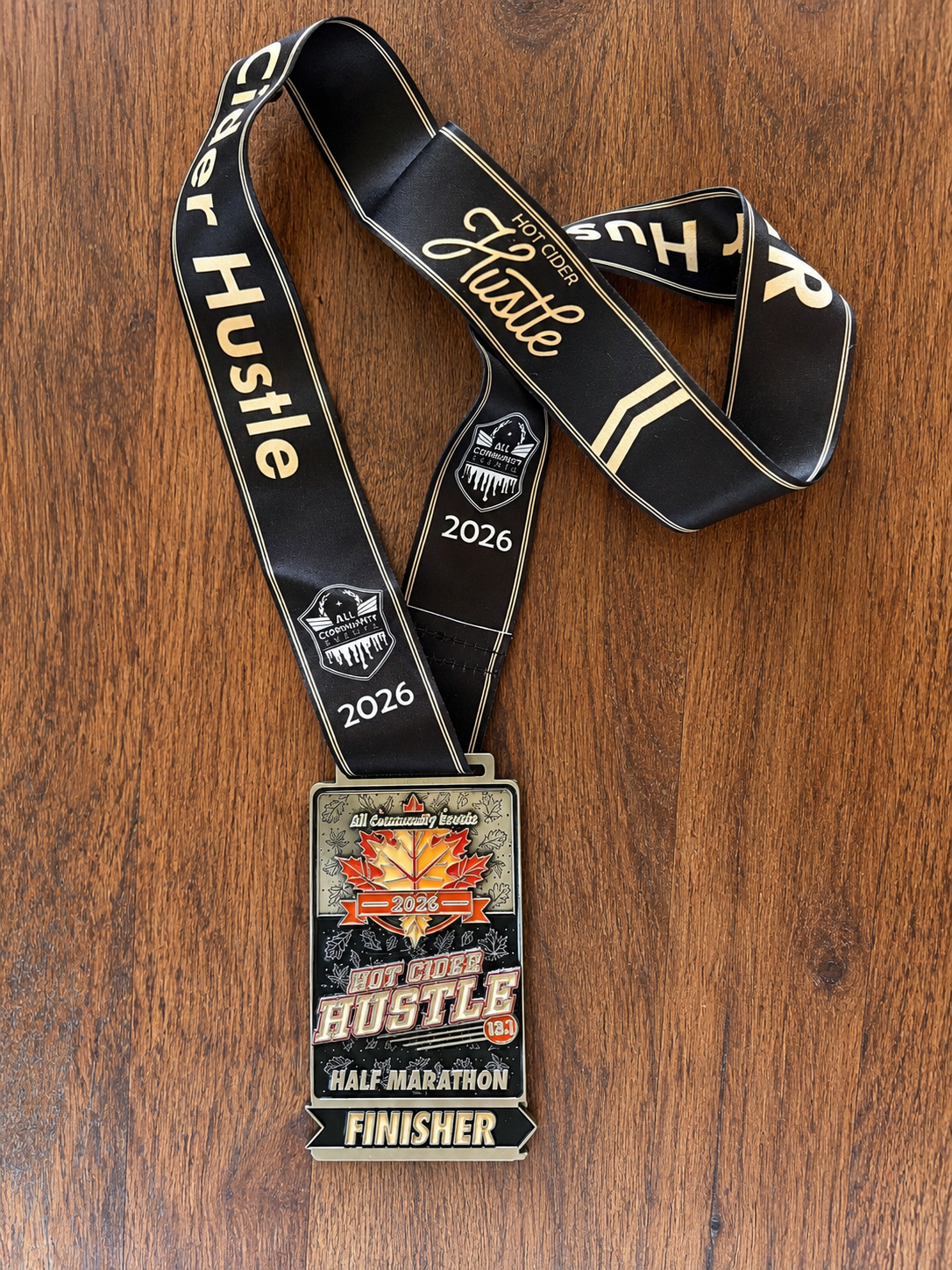
On October 25, 2026, at 51 years old, I completed my first half marathon.
My watch recorded 13.3 miles. My finishing time was 2 hours, 9 minutes, and 30 seconds. I even finished second in my age group.
Sounds pretty good, right?
Well, let me tell you something.
It was REALLY hard.
When I crossed that finish line, I wasn’t thinking about my time. I wasn’t thinking about my age-group finish. I was exhausted, proud, relieved, and, quite frankly, glad the whole thing was over.
And by the whole thing, I don’t just mean the race.
I mean the months of training, the injuries, the uncertainty, the early runs, the long runs, and the days when I wondered whether I was going to make it to the starting line at all.
But looking back, I’m glad I did it.
And the best part had nothing to do with running.
It Started With One Manageable Step
I didn’t wake up one morning and decide I was going to run 13.1 miles.
My running journey started with shorter distances. One mile eventually became a 5K. Then came a 10K.
As I became more comfortable, I started wondering what else I might be capable of.
That’s when the half marathon entered the picture.
I set my sights on October 25 and started working toward it.
There was no magic formula. I ran consistently, gradually increased my distance, and tried to balance training with the rest of my life.
Some days were encouraging. Other days were anything but.
And I learned pretty quickly that having a training plan doesn’t mean everything will go according to that plan.
Then Came the Setbacks
Early in my training, a hip problem took me out of running for roughly two weeks.
That was frustrating enough.
Then, in August, I started experiencing pain around my Achilles tendon near the heel.
This wasn’t simply being a little sore after a workout. At times, walking the next day was difficult.
I didn’t run for a month.
Suddenly, the question wasn’t how fast I could run my half marathon.
It was whether I’d be able to run it at all.
I had already put in a lot of work. Stopping wasn’t what I wanted to do, but continuing to push through the problem wasn’t a good answer either.
So I rested, adjusted my training, and eventually started rebuilding.
And when I say rebuilding, I mean starting small again.
Learning to Run Again
I returned with walk-and-jog intervals.
Five minutes walking, two minutes jogging.
Eventually, the jogging portions became longer and the walking portions became shorter.
It wasn’t particularly glamorous.
Nobody’s making a highlight video of a 51-year-old guy checking his watch to see if his two minutes of jogging are finished.
But those sessions mattered.
Little by little, I started running continuously again.
Then came three miles. Four miles. Five miles.
Eventually, I worked my way back to longer runs.
There were days when my legs felt heavy and my energy wasn’t there. I made mistakes with fueling and learned that what I ate, drank, and did the night before a long run mattered.
My longest training run before the race was 11 miles.
That was enough for me to know the half marathon was going to be difficult.
But it also gave me reason to believe I could finish.
Race Day: October 25, 2026
When race day finally arrived, I knew I had done what I could to prepare.
I also knew I hadn’t followed some perfect training schedule.
There had been interruptions, changes, and compromises along the way.
But I was standing at the starting line.
And that was something.
My strategy was simple: keep moving, manage my energy, and walk briefly when drinking water.
As the miles added up, the race got harder.
Then harder.
Then harder still.
I wasn’t cruising along thinking about how enjoyable this whole experience was.
I was working.
And when I finally crossed the finish line, I was spent.
13.3 miles. 2:09:30. Second place in my age group.
I had done it.
The Best Part Wasn’t the Finish Time
Here’s what mattered most to me.
My kids were there.
They got to see their dad set a difficult goal, work toward it for months, deal with setbacks, and ultimately finish what he started.
Not because I needed to impress them.
Not because I wanted them to think their dad was some great athlete.
I wanted them to see what commitment looks like.
I wanted them to understand that accomplishing something difficult usually involves more than enthusiasm at the beginning.
There are going to be setbacks.
There are going to be days when things don’t go right.
Sometimes you’re going to have to change your approach.
Sometimes you’re going to have to start rebuilding from a place you thought you’d already moved beyond.
But you can keep working toward something that matters to you.
That’s what I hoped they would take away from watching this journey.
And that meant more to me than any finishing time ever could.
So, Am I Done Running?
Funny thing.
On race day, I remember thinking that I might not run again for quite a while.
Maybe not until spring.
I had certainly had enough running for one day.
But a couple of days later, I found myself thinking about signing up for another 5K in November or December.
In the cold.
Apparently, exhaustion has a short memory.
I’m not sure what running will look like for me this winter, and I still need to respect the soreness and recovery that come with a demanding race.
But I do know this.
I’m glad I took on the challenge.
Not because I ran a particular time or finished in a particular place.
I’m glad because I committed to something, worked through difficult stretches, and saw it through.
And because my kids were there to see it.
What I’d Tell Someone Thinking About Their First Race
You don’t have to start with a half marathon.
You don’t even have to start with a 5K.
Start with something manageable.
Build consistency. Increase gradually. Respect injuries and recovery. Make adjustments when life or your body demands them.
And don’t get so focused on the final destination that you forget to recognize the progress you’re making along the way.
My half marathon wasn’t where my running journey began.
It was simply the next challenge.
And it taught me something I hope my kids remember, too:
You don’t have to know exactly how you’re going to accomplish something before you begin.
You just have to be willing to commit, start, keep learning, make adjustments, and continue working toward it.
Small steps. Big finish.
This is a personal account of my running experience, not a training prescription. Running involves physical risks, and training should be adjusted to individual health, fitness, and recovery needs.
