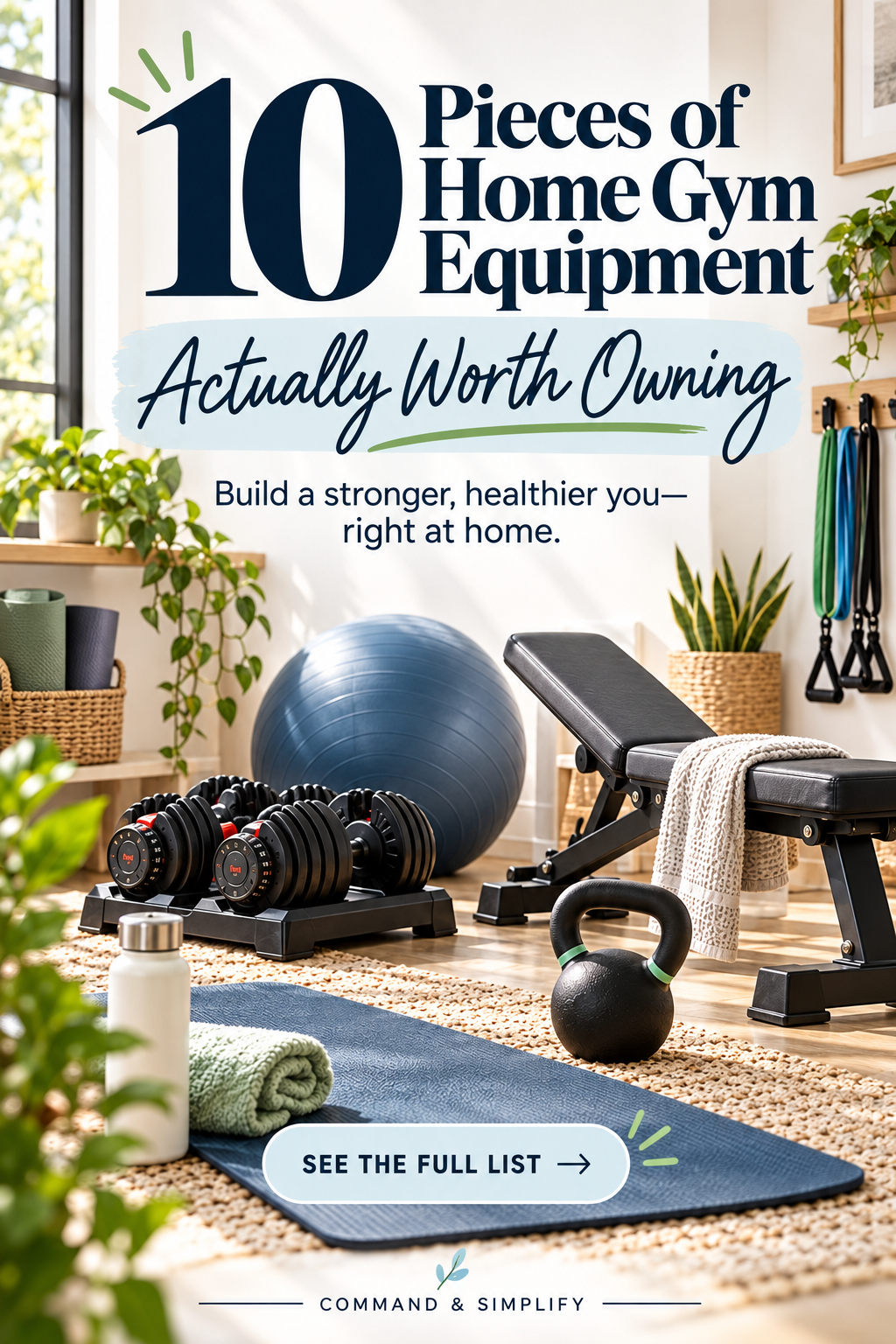
Build a practical home gym without spending a fortune—or turning your spare bedroom into a fitness equipment warehouse.
By Command & Simplify | Fitness & Wellness
Let’s get something straight right away: you don’t need a garage full of expensive exercise equipment to get a good workout.
You don’t need a dozen machines or a wall of mirrors. You need equipment you’ll actually use.
A home gym can be a great investment—if you have the space and you’re actually going to use the equipment. Otherwise, it can quickly become the most expensive catch-all room in the house. Before you know it, the treadmill is holding laundry, the weight bench is covered in boxes, and your exercise bike has become a deluxe drying rack.
The goal isn’t to fill a room with equipment. It’s to create a workout space you’ll actually use.
I’ve spent plenty of time running, rowing, lifting weights, and doing bodyweight exercises. Over time, I’ve found that some of the simplest equipment can be the most useful.
Dumbbells, kettlebells, a good exercise mat, and a rowing machine can provide a tremendous variety of workouts without requiring a commercial gym.
I’ve also found ways to make basic exercises more challenging using a weighted vest.
For this guide, we’re combining that firsthand workout experience with additional equipment recommendations for different fitness levels and budgets.
These aren’t ten things everyone must buy. They’re ten pieces of equipment worth considering, with explanations of what each does, who might benefit, and where you can save money.
Affiliate disclosure: This article contains affiliate links. Command & Simplify may earn a commission if you purchase through these links, at no additional cost to you. Recommendations are based on practical usefulness, personal experience where noted, and product research—not commission rates.
1. Dumbbells: The Foundation of a Practical Home Gym
If I could recommend only one piece of strength-training equipment, dumbbells would be near the top of my list.
They’re versatile, easy to store, and useful for dozens of exercises.
I regularly incorporate dumbbells into workouts, including curls, rows, shoulder presses, and exercises that combine several movements.
One thing I’ve learned is that having more than one weight makes a big difference.
My preferred home setup includes:
- 8-pound dumbbells: Useful for lighter exercises and movements involving smaller muscle groups.
- 15-pound dumbbells: A practical intermediate option for curls, presses, and other exercises.
- 20-pound dumbbells: Helpful when additional resistance is appropriate.
Those are personal preferences, not universal starting weights. Choose resistance based on your strength, technique, and the exercise.
Our recommended product
Power Systems Rubber Hex Dumbbells
These fixed-weight dumbbells come in multiple weight options. The hexagonal design also helps keep them from rolling around the floor.
View Rubber Hex Dumbbells at Power Systems
My advice: Start with the weights you’ll use most often. You can add heavier pairs as you get stronger.
There’s no prize for owning a 50-pound dumbbell you can’t safely lift.
2. Adjustable Dumbbells: The Space-Saving Alternative
Fixed-weight dumbbells are great, but there’s one obvious disadvantage.
The more pairs you buy, the more floor space they occupy.
Adjustable dumbbells solve that problem by combining several weight options into one compact system.
They’re especially useful for people who want a variety of weights without purchasing and storing a large collection.
Our recommended product
Power Systems Adjustable Dumbbell Set
This is a premium alternative worth considering for people who value versatility and limited storage space.
View Adjustable Dumbbell Set at Power Systems
When we reviewed the product, the listed options ranged from approximately $349.99 to $529.99, depending on configuration. Confirm the current price and weight range before purchasing.
My advice: You don’t need both fixed-weight dumbbells and an adjustable set. Pick the approach that makes the most sense for your budget, training needs, and available space.
3. Kettlebells: One Weight, Plenty of Exercises
Kettlebells are another piece of equipment I personally enjoy using.
They can add variety to traditional strength training, and their handle design makes them useful for exercises such as carries, squats, deadlifts, and certain swinging movements.
A kettlebell doesn’t replace every dumbbell exercise, but it offers different movement possibilities.
And you don’t need a whole collection to get started.
Our recommended product
Power Systems Kettlebell Prime
We compared the Elite Kettlebell and Kettlebell Prime before choosing this option.
The Prime offered a better price for the 15-pound version when we checked:
- 10-pound option: $43
- 15-pound option: $52
Several other weights were also available. Check the current price and stock for your chosen size.
View Kettlebell Prime at Power Systems
My advice: Begin with controlled exercises and learn proper technique before attempting heavy or fast kettlebell swings.
4. An Exercise Mat: Simple, Affordable, and Surprisingly Useful
An exercise mat might not be the most exciting fitness purchase you’ll make, but it’s one of the most practical.
I use a mat for floor exercises, including planks, core workouts, and other bodyweight movements.
A decent mat creates a defined workout space and makes certain floor exercises more comfortable.
It’s also easy to put away when you’re finished.
Our recommended product
Power Systems Premium Yoga Sticky Mat
We selected the navy, quarter-inch-thick version.
When checked, it was in stock for $24.50.
The thickness offers cushioning for many common floor exercises while remaining easy to store.
View Premium Yoga Sticky Mats at Power Systems
My advice: For people who spend a lot of time kneeling or performing floor exercises, mat thickness matters. Choose enough cushioning for your comfort without sacrificing stability.
5. A Stability Ball: A Useful Optional Core-Training Tool
Stability balls aren’t essential for everyone, but they can add variety to core workouts, balance exercises, and controlled strength-training movements.
The unstable surface changes the demands of certain exercises, requiring additional attention to balance and body position.
They’re also relatively inexpensive compared with many other fitness products.
This is an equipment recommendation based on its potential uses, not a product I’ve personally tested.
Our recommended product
Power Systems VersaBall Stability Ball
We found two available sizes:
- 55 cm — $28
- 65 cm — $33
Both were in stock when checked.
View VersaBall Stability Ball at Power Systems
My advice: Choose a ball that fits your height and intended exercises, and follow the manufacturer’s inflation and safety guidelines.
If you’re already happy with your core routine, this is an optional purchase—not something you need to rush out and buy.
6. A Jump Rope: Cardio Without Taking Up a Room
Some fitness equipment costs hundreds of dollars and requires a dedicated space.
A jump rope costs a few dollars and fits in a drawer.
That’s a pretty good deal.
Jumping rope can provide a challenging cardiovascular workout while also developing coordination and rhythm.
It’s a useful option for people who want short, active sessions without a large machine.
Of course, jumping isn’t appropriate for everyone. Anyone dealing with foot, ankle, Achilles, or knee problems may be better served by lower-impact activities.
Our recommended product
Power Systems Speed Rope
When we researched it, the rope was offered in three sizes, priced from $5 to $6, with all three in stock.
View Speed Rope at Power Systems
My advice: Get the proper rope length, start with brief sessions, and build up gradually.
You don’t have to jump for twenty minutes straight to benefit from using one.
7. A Foam Roller: An Optional Recovery Accessory
Foam rollers are popular for self-massage, mobility routines, and temporarily reducing feelings of muscle tightness.
They’re not magic, and they aren’t a substitute for sleep, recovery time, or sensible training.
But some people find them helpful.
I don’t personally use a foam roller as part of my regular workout routine, so I’m not going to pretend it’s something I can’t live without.
This is one of the optional items on our list.
Our recommended product
Power Systems High Density Foam Roller
We found three in-stock options:
- Standard size — $14.95
- 18-inch — $19.95
- 36-inch — $39.95
View High Density Foam Roller at Power Systems
My advice: Start gently, avoid rolling directly over painful joints or injured tissue, and treat foam rolling as an optional addition to your recovery routine.
8. A Weighted Vest: Make Familiar Exercises More Challenging
One piece of equipment I personally use is an 8-pound Athletic Works weighted vest.
Mine is the older black neoprene model with padded shoulder straps and adjustable buckles.
I use it for several activities:
- Walking
- Squats
- Push-ups
- Planks
- Occasionally running
What I like about a weighted vest is that it adds resistance without requiring me to hold weights in my hands.
Bodyweight exercises that have become familiar can feel more challenging with a little additional load.
But here’s an important distinction: A weighted vest is not necessary for beginners.
Added weight increases the demands on your muscles, joints, and connective tissues. Running with a vest deserves particular caution because it increases loading with every step.
Our recommended product
Athletic Works 8 lb Weighted Vest
This is the model I personally use. However, availability has been limited, and we haven’t confirmed an eligible Walmart affiliate link.
Product link to be added when availability and affiliate eligibility are verified.
My advice: Get comfortable with the unweighted exercise first. Start with short, controlled sessions, and increase resistance cautiously.
For someone already comfortable performing push-ups, squats, and planks, a modestly weighted vest may provide useful variety.
9. A Rowing Machine: My Favorite Cardio Investment
This is one of the bigger purchases on the list, but it’s also one of my personal favorites.
I own a MERACH rowing machine, purchased through Walmart, and I really enjoy using it.
Rowing has become a regular part of my fitness routine.
I use it alongside running, strength training, and other activities.
What I appreciate about rowing is that it provides a workout involving both the upper and lower body while offering a lower-impact alternative to running.
You can adjust the intensity for an easier session or push yourself for a more demanding cardiovascular workout.
And unlike a treadmill, a rowing machine gives your arms something to do besides wondering how much longer you’re going to be on the treadmill.
My personal recommendation
MERACH Rowing Machine
This is the brand I personally own and use.
We still need to verify the exact model and its current availability at Walmart before recommending a specific listing.
Product link to be added after model verification and, if approved, Walmart affiliate eligibility confirmation.
My advice: A rowing machine isn’t the first piece of equipment everyone needs to purchase. But if you enjoy rowing and want an indoor cardio option, it’s worth considering.
Before purchasing, pay attention to the machine’s footprint, resistance system, comfort, weight capacity, and storage requirements.
10. Resistance Bands: Affordable Strength Training Almost Anywhere
Resistance bands might be the simplest way to add exercise variety without taking up much space.
They’re portable, inexpensive, and useful for many types of resistance training.
You can use them for controlled upper-body exercises, lower-body movements, and certain warm-up routines.
Different band strengths also make it easier to adjust resistance.
Although dumbbells and kettlebells are my personal strength-training staples, bands are worth considering because they’re so convenient.
Our recommended product
Power Systems Fabric Resistance Bands
When we researched this product, the three-band kit was listed for $20.
View Fabric Resistance Bands at Power Systems
My advice: Inspect resistance bands for wear before using them, and choose resistance levels you can control through the intended movement.
They’re particularly useful for people who need equipment that’s easy to pack or store.
What Home Gym Equipment Can You Skip?
Let’s talk about the stuff you probably don’t need right away.
When you’re building a home gym, it’s easy to get distracted by machines that promise incredible results.
But buying more equipment doesn’t automatically mean getting better workouts.
Before spending money, ask yourself three questions:
Will I actually use it?
A simple pair of dumbbells used three times a week is more valuable than an expensive machine collecting dust.
Does it provide something my existing equipment doesn’t?
If you already have dumbbells and a kettlebell, you may not need another piece of equipment that performs essentially the same exercises.
Do I have space to store it?
A home gym should make your life easier, not force you to climb over equipment to reach the washing machine.
For most beginners, I’d postpone expensive multi-station machines, oversized weight racks, specialty exercise gadgets, and equipment that serves only one narrow purpose.
How I’d Build a Home Gym on a Budget
If I were starting from scratch, I wouldn’t purchase all ten items at once.
I’d start small.
First purchases: A pair of appropriately weighted dumbbells, an exercise mat, and perhaps resistance bands.
Next additions: A kettlebell or a jump rope, depending on whether strength or cardio is the bigger priority.
Later upgrades: Equipment such as a rowing machine, adjustable dumbbells, or a weighted vest—only when it fits your routine and budget.
A stability ball or foam roller can be useful additions, but neither is mandatory.
The goal isn’t to own ten products.
The goal is to have the right tools for workouts you’ll actually do.
My Final Takeaway
After years of exercising in different ways, I’ve come to appreciate simple, practical equipment.
Dumbbells are versatile. Kettlebells add variety. An exercise mat makes floor workouts more comfortable. My MERACH rower provides an indoor cardio option I genuinely enjoy.
And an 8-pound weighted vest lets me add a little resistance to exercises I already do.
But none of these tools does the work for you.
The most useful home gym isn’t necessarily the most expensive.
It’s the one you actually use.
Start with what fits your goals, add equipment when you need it, and don’t feel pressured to fill every corner of your house with fitness gear.
That’s a simpler—and often more affordable—way to build a home gym that works.
More from Command & Simplify
If you’re working on improving your fitness, you may also enjoy:
- Your First 5K: What You Actually Need (and What You Don’t)
- What to Bring on Your First Long Run: The Essentials for 6–10 Miles
- Post-Run Recovery After 50: What Actually Helps (and What Doesn’t)
Command & Simplify — Practical Tools for a Simpler Life.
Editorial note: Prices and availability were checked during product selection in October 2026 and can change. Product-specific firsthand experience is distinguished from researched recommendations. Affiliate links should be tested for tracking and current availability before publication.
