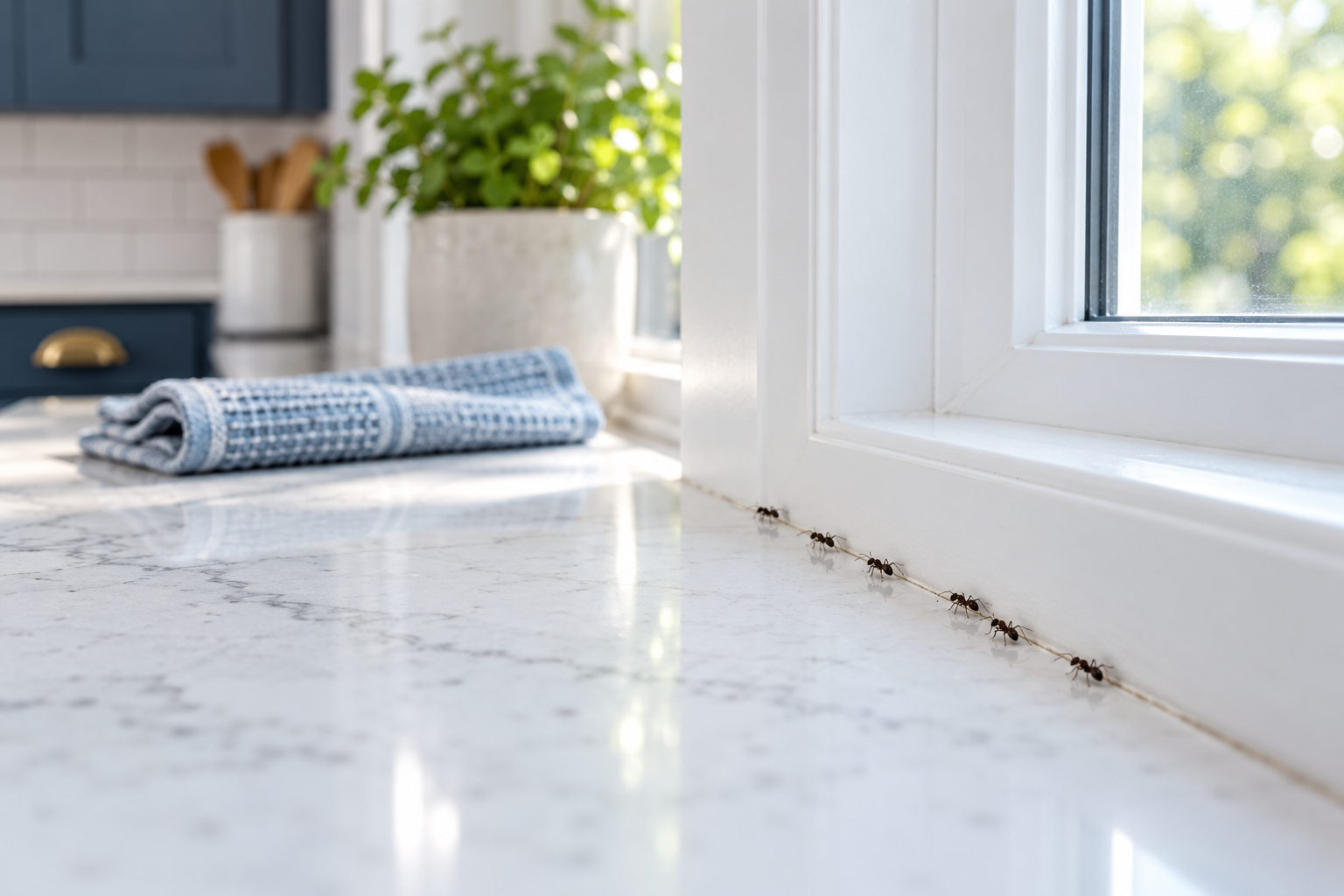
You walk into the kitchen and see a few ants on the counter.
You kill them.
A couple of hours later, there are more.
So you clean the counter, spray the ants you can see, and figure the problem is handled.
The next morning?
They’re back.
If you’ve dealt with ants before, you know how frustrating this can get.
I owned a pest-control company for about 20 years, and ant problems were something we dealt with constantly. One of the biggest mistakes I saw homeowners make was focusing only on the ants they could see inside the house.
Those ants may only be a small part of what’s actually going on.
The good news is that you don’t need to drown your house in pesticide to control ants.
You need to understand the problem first.
Figure Out How Big the Problem Is
Before reaching for a spray or bait, spend a few minutes looking at what the ants are actually doing.
Ask yourself:
- Are you seeing one or two ants occasionally?
- Are there dozens of ants?
- Is there an established trail?
- Are they showing up in one room or several?
- Are they appearing around the same area every day?
- Can you see where they’re entering?
A couple of wandering ants is different from an established trail running across your kitchen counter.
And ants appearing throughout several parts of the house may indicate a larger problem than a few scouts.
Don’t immediately start spraying everything.
First, investigate.
Ant species matter, too. If you cannot identify the ants, your local cooperative extension service or a pest-control professional can help you choose an appropriate approach.
Don’t Just Kill the Ants You See
This is probably the most important concept in this entire guide.
The ants walking across your counter aren’t necessarily the whole problem.
There may be many more ants:
- inside a wall
- underneath the house
- around the foundation
- beneath a patio or deck
- in landscaping
- somewhere else outside the house
If you spray the ten ants walking across the counter, congratulations—you killed ten ants.
But you may not have done much to the colony producing them.
That’s why successful ant control usually requires thinking beyond the ants you can see.
Think Inside AND Outside
When I handled recurring ant problems professionally, I didn’t look only at the kitchen counter.
I wanted to know what was happening around the entire structure.
Walk around the outside of your house and look carefully.
Pay attention to areas around the foundation, doors, windows, patios, decks and other places where ants may be active.
Look at tree branches, bushes or other vegetation touching the structure.
And most importantly:
Watch the ants.
If you find an established trail outside, follow it.
Ants are giving you information.
You may discover a trail running along the foundation, across a patio, up an exterior wall or toward the house.
Finding that activity can help you understand why ants keep appearing inside.
One of the things I saw repeatedly during my pest-control years was homeowners using indoor bait over and over while never looking outside.
The bait might kill ants.
But if significant exterior activity or pressure isn’t being addressed, you can find yourself putting out more bait every time ants return.
At that point, you’ve basically opened an all-you-can-eat ant buffet.
There Are a LOT of Ants Out There
Sometimes homeowners feel like they must be doing something wrong because ants keep appearing.
Not necessarily.
Ants are everywhere.
A major scientific estimate published in 2022 put the number of ants on Earth at roughly 20 quadrillion.
That’s approximately 2.5 million ants for every person on the planet at the time of the estimate.
So if a few decided to stop by your kitchen, you’re not exactly beating impossible odds. 😂
The point isn’t that you should accept ants living in your house.
It’s that having ants does not automatically mean your house is dirty.
Sometimes you simply get ants.
The goal is to understand why they’re there and deal with the problem intelligently.
If the Ants Are Eating the Bait, Leave Them Alone
This is where a lot of homeowners accidentally interfere with the treatment.
You put out ant bait.
The ants find it.
Suddenly there seem to be more ants around the bait than there were before.
Your first reaction might be:
This stuff is making the problem worse.
Not necessarily.
If ants are actively feeding on the bait, that’s usually exactly what you want them to do.
Baits are designed so ants can feed on them and carry the material away from the bait placement.
So if ants are feeding:
Don’t kill them.
Don’t wipe them up.
Don’t panic because you’re seeing more activity around the bait.
Give them an opportunity to do what the bait is designed to let them do.
This applies to ants feeding at a properly placed bait. Keep cleaning food spills and crumbs elsewhere; never leave ants on food or food-contact surfaces just to preserve a trail.
Don’t Spray Around Your Bait
Another common mistake is combining bait with a spray in the same area.
A homeowner sees ants feeding on bait and thinks:
I’ll really get them now.
Then they spray the ants and the area surrounding the bait.
That can work against what you’re trying to accomplish.
If you’re using bait, you generally want ants to approach it and feed.
Spraying pesticides or strong cleaners around the bait area may interfere with that.
If the ants are feeding on the bait, resist the urge to attack the ants you can see.
Sometimes doing less is the better strategy.
You Don’t Need a Mountain of Gel
More bait isn’t automatically better.
One mistake I saw was homeowners assuming that if a little bait was good, squeezing out a huge pile must be even better.
That’s not how I approached baiting professionally.
Use the product according to its current label and follow its directions for placement and amount.
Keep all pesticides and bait placements out of reach of children and pets, and away from food. Use only locations permitted by the current product label, including its restrictions for food-preparation areas.
The objective is to provide appropriate bait placements where ants can find and feed on them—not decorate the kitchen with ant gel.
And always place pesticides where the label allows, especially around children, pets and food-preparation areas.
Give the Bait Time
Ant bait isn’t necessarily an instant treatment.
That’s part of the point.
If you’re expecting every ant to disappear within an hour, you may decide the treatment failed long before you’ve given it a reasonable opportunity to work.
When I dealt with ant problems, I didn’t judge bait based on what happened in the first few hours.
Give the treatment some time.
As a practical rule, I would usually reassess the situation after about a week to see whether we were making progress. That didn’t necessarily mean the bait had failed if ants were still present—some bait treatments can take considerably longer. Always follow the current product label.
But don’t put bait out Monday morning and declare it useless Monday afternoon.
What If the Ants Ignore the Bait?
Now we have a different situation.
You put the bait down.
The ants walk right past it like it’s broccoli.
First, don’t immediately assume that all ant bait is useless.
Check the bait itself.
How old is it?
How has it been stored?
Has it been sitting in a hot garage for years?
Is it dried out or otherwise in poor condition?
Sometimes that tube has been rolling around in the garage so long it should be paying rent. 😂
Also remember that different ants and different situations may respond differently to different bait formulations.
If ants aren’t interested in one appropriate bait, another bait or formulation may be worth considering.
That does not mean putting five different pesticides everywhere and hoping something works.
It means slowing down and diagnosing the problem.
Don’t Obsess Over One Entry Point
Finding where ants are entering is useful.
But don’t assume that sealing one tiny crack automatically solves the entire problem.
Ants can use extremely small openings, and a structure can have many potential entry points.
Rather than spending hours trying to identify one magical crack, look at the bigger picture:
Where are the ants active?
Where are the established trails?
What’s happening around the exterior?
Are there branches or bushes contacting the house?
Are there food or water sources attracting activity?
The goal isn’t simply to block one ant.
It’s to understand what’s happening around the property.
A New Ant Trail May Be a Different Colony
Here’s another situation that can confuse homeowners.
You treat one area successfully.
The ants disappear.
Then later you see ants somewhere else.
It’s tempting to assume:
The treatment just moved them.
Not necessarily.
A new trail in another location may represent completely different ant activity.
Remember—there are a lot of ants out there.
That’s why I prefer looking at the whole property instead of treating every ant trail as though it must be part of one giant colony.
Does Having Ants Mean Your House Is Dirty?
No. Not necessarily.
Can cleanliness contribute to an ant problem?
Absolutely.
If you’ve got a greasy stovetop, unswept floors, food debris on the counters or crumbs regularly left around, you’re giving ants additional food sources.
Cleaning those things up should be part of addressing the problem.
Also repair leaks, store food in sealed containers, trim vegetation away from the house and seal accessible entry gaps as part of prevention.
But here’s the other side of it:
I’ve seen ants in spotless houses.
You can keep an extremely clean home and still get ants.
So don’t assume that seeing an ant trail across your kitchen means you’re doing something wrong.
Cleanliness matters, and removing available food sources can help. But a clean house isn’t some invisible force field that ants can’t cross.
Sometimes a clean house gets ants too.
When It’s Time to Call a Professional
I’m a big believer in letting homeowners handle a reasonable ant problem themselves if they’re comfortable doing it.
But there comes a point when DIY stops making sense.
For me, there are two big signs.
1. You Have a LOT of Ants
I’m not talking about five ants wandering around the kitchen.
I’m talking about heavy activity.
Multiple trails.
Hundreds of ants.
Ants seemingly everywhere.
If you’re looking around the property and thinking, This is a lot bigger than a few ants coming through the kitchen window, I’d consider calling a pest-control professional.
In fact, if the infestation is already that heavy when you first discover it, you may want to skip the DIY stage altogether.
2. You Can’t Get Rid of the Few Ants You Have
The opposite situation can be just as frustrating.
Maybe you don’t have hundreds of ants.
You only have a few.
But they won’t go away.
You treat one area.
They disappear.
Then they’re back.
You try something else.
Now you’re seeing them somewhere else.
Eventually you start feeling like you’re chasing the ants around the house.
That’s another point where I’d consider bringing in a professional.
Not necessarily because the number of ants is overwhelming, but because you’ve tried to solve the problem and aren’t getting control of it.
There’s no prize for spending the next two months chasing six ants around your kitchen.
Sometimes it’s simply time to let somebody who deals with these problems every day take a look.
If You’re Calling a Professional, Don’t Destroy the Evidence
If you’ve decided to call a pest-control professional, here’s something that can actually help them:
Leave the ants alone if you can.
If leaving activity undisturbed would be unsafe or unhygienic, take clear photos of the ants and their trail before cleaning the area.
I would much rather arrive at a customer’s house and see an active ant trail than hear:
“There were hundreds of them right here, but I sprayed everything before you came.”
When the ants are still active, I can study them.
Where are they coming from?
Where are they going?
What path are they following?
Can I follow that activity toward an entry point or another area of the property?
Those ants aren’t just the problem.
They’re also giving the technician clues about the problem.
If you kill everything you can see right before the professional arrives, you’ve potentially removed some of the information they could have used during the inspection.
So if you’ve already made the decision to bring someone in and the situation allows it:
Don’t clean up the evidence before the detective arrives.
Let the professional see what’s actually happening.
Pest Control Starts With Investigation
If there’s one idea I’d like homeowners to take away from this guide, it’s this:
Don’t start with the pesticide. Start with the investigation.
During my years in pest control, I needed to be an investigator.
Where are the ants?
Where are they going?
Where are they coming from?
What’s happening outside?
Are they feeding on the bait?
Is there one trail or activity in several areas?
The answers to those questions can tell you much more than simply killing the ants standing in front of you.
It’s similar to something I encountered with termites.
Sometimes a homeowner would call because they believed they’d found termite activity. I’d arrive and discover they’d already cleaned up the termite droppings.
Now I had less information to work with.
Those droppings were evidence.
I wanted to see where they were and what was happening around that area.
The same basic principle applies to ants:
Observe first. Treat second.
You Don’t Have to Win the War in One Day
Seeing ants in your kitchen is annoying.
I understand the instinct to grab something and start spraying.
But slow down for a minute.
Watch them.
Look inside and outside.
Follow the trails you can find.
Remove unnecessary food sources.
If you’re using a bait and the ants are feeding on it, let them feed and give the treatment an opportunity to work.
If you’re dealing with heavy activity—or you’ve reached the point where you feel like you’re constantly chasing a few stubborn ants around the house—it may be time to bring in a professional.
You don’t need to panic.
You don’t need to cover the house in pesticide.
And you don’t need to kill every ant you see within the next five minutes.
Investigate the problem. Understand what you’re seeing. Then decide how to treat it.
That’s how I approached ant problems professionally.
And it’s where I’d recommend a homeowner start too.
Make a simple plan for the next step. Note where you see activity, what you have tried and when you plan to reassess. Our free Daily Command List gives you a place to keep those reminders alongside the rest of your day.
Further reading: UC IPM: Ants and EPA: Do’s and Don’ts of Pest Control. Professional experience informs this guide; current product labels govern pesticide use.
